provided by Sam Fogg Gallery
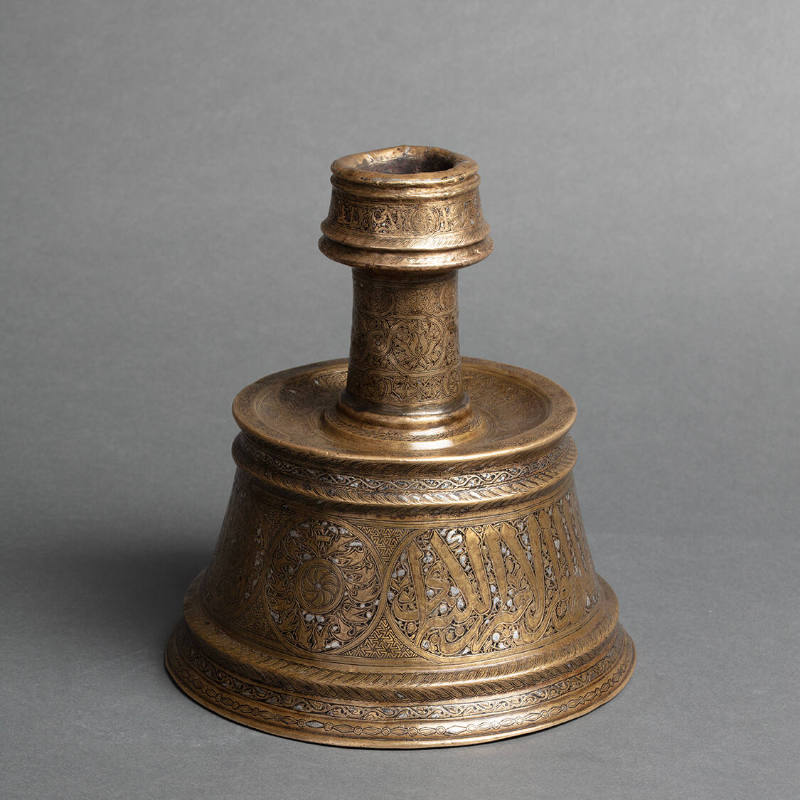
Candlestick
provided by Sam Fogg Gallery

Candlestick

Artist Unknown
CultureEgypt
Dateca.1320-1340
MediumBrass with gold and silver inlay
Dimensions9 11/16 × 8 7/16 in. (24.6 × 21.5 cm)
InscribedThe inscription around the drum, or body, reads (translated from Arabic): “The High Authority, the Lordly, the Great Amir, / the Just, the Holy Warrior, the Possessor of Wealth, the [officer of] al-Malik al-Nasir.” A similar inscription runs around the drip tray: “The High Authority, the Lordly, the Great Amir, the Holy / Warrior, the Defender, the Protector of Frontiers, the One helped [by God], the [Officer of] al-Malik al-Nasir.” Another inscription around the socket continues: “The High Authority, / the Lordly, the Great Amir, the Learned / the [Officer of] al-Malik al-Nasir.”
Credit LineMuseum purchase
Object number2023.14
On View
Chrysler Museum of Art, Gallery 201

Label TextArtist unknown (Possibly Syria) Candlestick, ca. 1320–40 Brass candlestick inlay with gold and silver . This beautiful candlestick was probably made in Syria during the Mamluk Sultanate (1250–1517). Many such Islamic objects are decorated only with writing, as the Q’uran forbids images. This one, however, features rosettes, lotus flowers, and ducks alongside Arabic inscriptions. Writing around the body states that the candlestick was made during the sultanate of al-Malik al-Nāsir (1293–1341), which marked a high point of stability and artistic achievement: The High Authority, the Lordly, the Great Amir, the Just, the Holy Warrior, the Possessor of Wealth, the [officer of] al-Malik al-Nāsir. Museum purchase 2023.14 ProvenancePrivate collection, Switzerland, between ca. 1980 and 2004 to Private collection, Switzerland to Christie’s, 25 April 2013, lot 89 to Sam Fogg Gallery to CMA (2023) Exhibition HistoryExhibited in Treasures of Islam, Geneva, 1985, no. 288.Published ReferencesToby Falk, ed., Treasures of Islam, exh. cat. (Geneva, 1985), no. 288, p. 278.